

Take this sentence:
“I think we could try this.”
Now replace it with:
“We should do this.”
You haven’t completely changed the proposal. But you have changed how you enter the conversation.
One version leaves room. The other takes a position.
Whether that is an improvement depends on who is speaking, who is reading, and what happened before the sentence arrived.
I wanted to build something that made a model’s reaction to these changes visible.
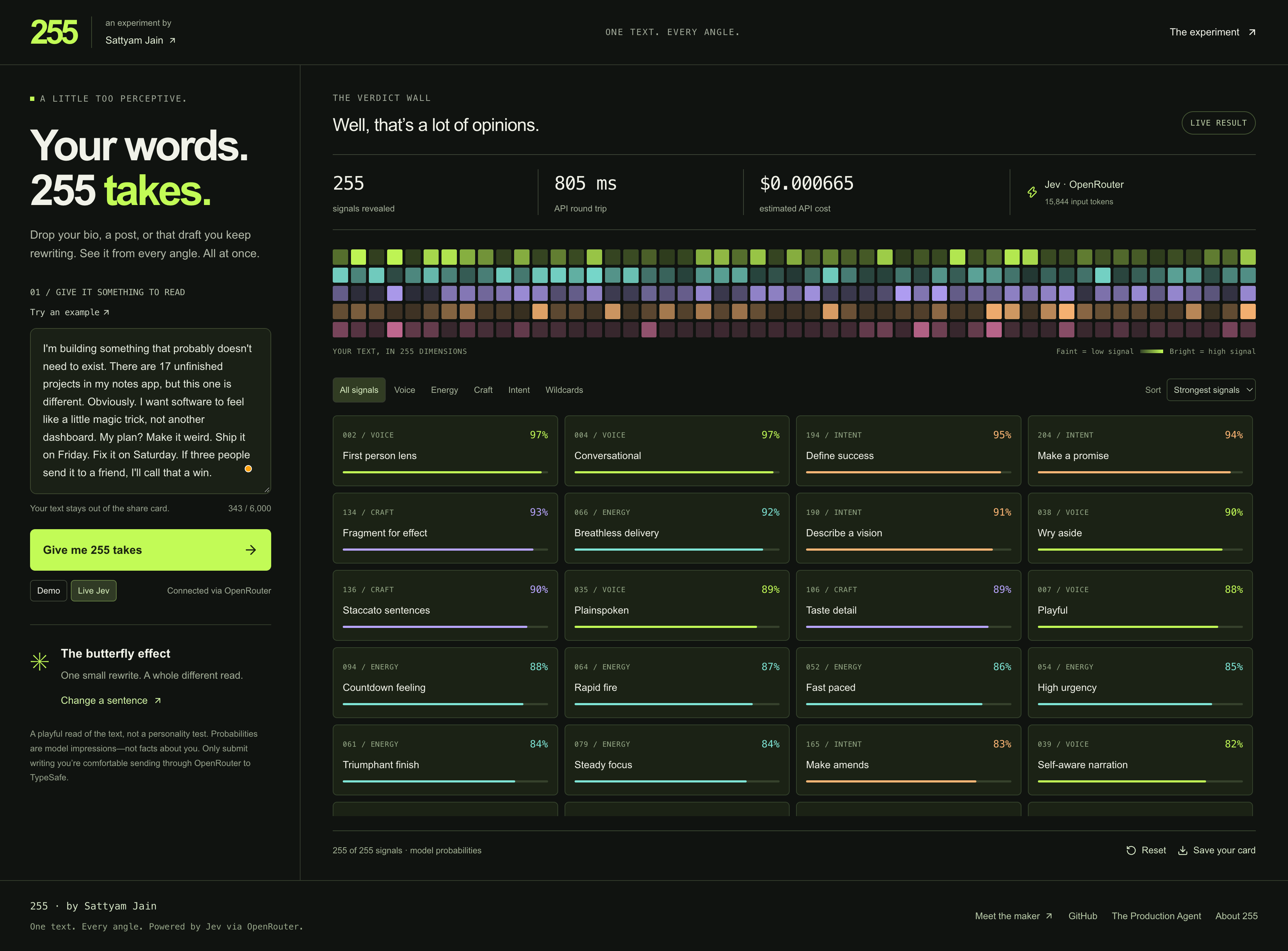
That experiment is called 255.
Why Jev caught my attention
Jev, from TypeSafe AI, is a decision model.
You supply the state you want evaluated and ask typed questions. Its answers include probabilities rather than a generated explanation.
For someone building an interface, that creates an interesting opportunity.
You can decide how those answers should behave on screen. They can become filters, indicators, comparisons, or controls.
I chose a wall.
Through OpenRouter’s Decisions API, 255 sends your writing alongside 255 fixed questions. The results become a grid of signals across voice, energy, craft, intent, and some more experimental categories.
You can inspect the signals individually, but the bigger question is what you do next.
The second version matters
My favourite interaction in the app is called “Butterfly Effect.”
You save your first result as a baseline. Then you edit the text, run it again, and compare the changes.
This gives the model’s judgments a reference point.
You can ask:
Did removing a qualifier change the apparent confidence?
Did adding context make the message easier to interpret?
Did shortening the paragraph make it clearer—or remove something important?
The app doesn’t establish the correct answer to those questions. It shows how Jev’s answers changed.
That distinction matters to me.
What the wall cannot tell you
I would be sceptical of a tool claiming to calculate the objectively perfect version of an email.
The probabilities in 255 have not been validated against a human evaluation dataset. A confident model response is not proof that a reader will share its interpretation.
And asking one model 255 questions does not turn it into a panel of 255 people.
Some signals may overlap. Some may respond too strongly to particular words. Some may miss what a human reader considers obvious.
These limitations are part of what I want people to explore.
A useful response to the wall might be: “Yes, that explains what bothered me.”
Another useful response might be: “That makes no sense. Let’s change one word and see what happens.”
A brief financial intermission
The product needed a name and a domain.
I wanted 255.ai.
The listing asked ₹2,45,19,230.76.
My salary did not support this creative direction.
So the experiment lives at get255.com.
The name itself comes from Jev’s support for up to 255 options in a Choice question, with a small nod to the unsigned eight-bit maximum. The app’s 255 separate questions are my own design choice.
Help me find the interesting failures
If you try it, use something you wrote yourself.
A paragraph whose intent you understand.
A message where a single word matters.
A pitch you are still unsure about.
Save a baseline. Change one sentence. Look at what moved.
I’m especially interested in examples where the change feels unreasonable. A striking interface is easy to enjoy; an interface that helps us investigate a model is more useful.
If you reply with an example, please use text you are comfortable sharing publicly.
— Sattyam Jain
One text. Every angle.