My Agent Memory Database Has Five Ways to Forget. None of Them Erase the Trail
In mnemo, forgetting is a signed event in a hash chain. What that buys (256 of 256 tamper checks caught), what it costs, and the retrieval result I can't claim yet.
When I sat down to design FORGET for mnemo, I assumed it would be the easy primitive. REMEMBER writes a record. RECALL reads records. FORGET deletes one. Done.
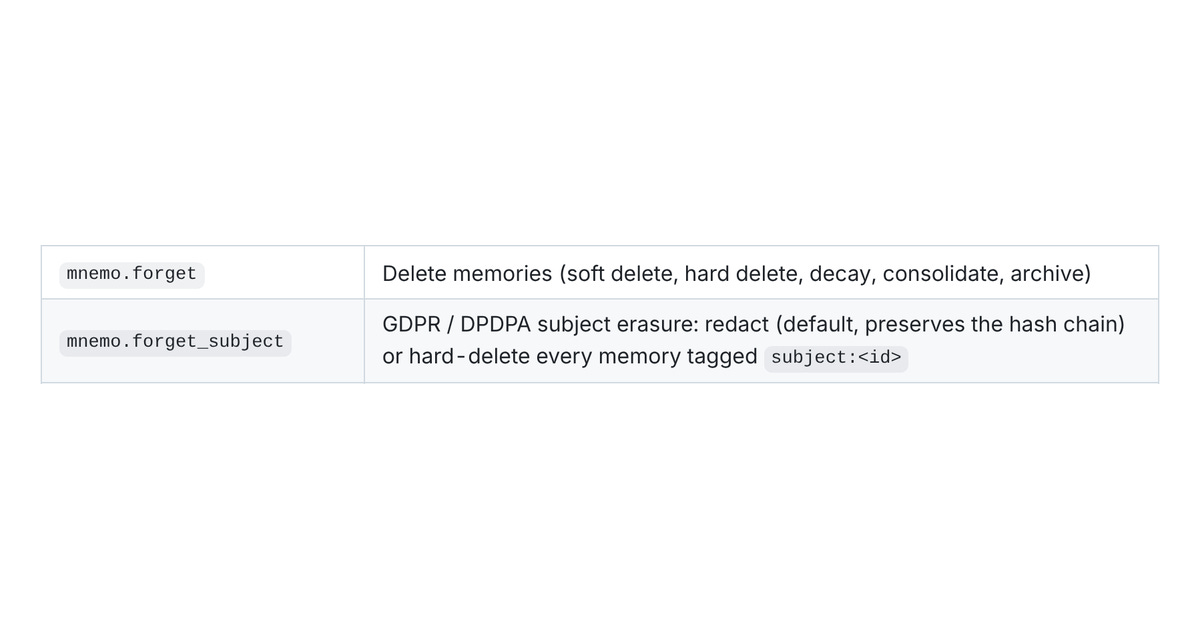
It took longer than the other three combined, and where it landed surprises people. In mnemo, forgetting is a write. Every forget appends a signed delete event to a hash chain. The memory leaves recall. The fact that it left, and who asked, stays.
If an agent can forget without leaving a receipt, it can also be made to forget without leaving one.
That line is the whole design. The rest of this is the thinking behind it, the numbers I can stand behind, and the one I can’t claim yet.
What mnemo is
mnemo is the memory database I build for agents in regulated settings. Rust, embedded, Apache-2.0. It runs in-process on DuckDB or against your own PostgreSQL, encrypts at rest with AES-256-GCM, and exposes four primitives as MCP tools: REMEMBER, RECALL, FORGET and SHARE. On top of those sit checkpoint, branch, merge and replay, so you can snapshot an agent’s memory, try something on a branch, and replay events from a known point.
The repo is at 324 commits. The last published release is 0.5.29, on PyPI on 3 September and crates.io on 4 September. It has 4 stars and 0 forks. I’m writing that down because the rest of this essay is about not hiding things, and it would be odd to start by hiding the adoption number.
Why delete is the wrong default for agent memory
My day job is Tech Lead for AI architecture at Attri.ai, where we build agents for enterprise customers in insurance, healthcare and legal AI, among others. For deployments like those, the question I care about is rarely how good recall is. It is closer to this: show me what the agent knew on the day it made that decision, and prove nobody changed it afterwards.
A plain delete fails that question twice.
The first failure is the obvious one. If an agent forgets something and the record is simply gone, you can no longer reconstruct what it was working from. Replay breaks. The audit trail has a hole exactly where a reviewer will look.
The second failure took me longer to see. Memory is an attack surface now. MINJA, a NeurIPS 2025 paper, showed that you can plant malicious records in an agent’s memory through ordinary queries, with no direct access to the store. The OWASP list for agentic applications files this under ASI06, memory and context poisoning. Once you accept that memory can be poisoned, you have to accept the mirror case: memory can be scrubbed. An attacker who plants a record and later gets it deleted leaves no trace in a store where delete means gone. The cover-up costs nothing.
So FORGET had to be something the chain records, the same way it records a write.
Five ways to forget
Once forgetting became an event, it turned out people mean very different things by it. mnemo ended up with five modes:
soft delete, hidden from recall but kept on disk
hard delete
decay, where low-importance records move to Archived or Forgotten
consolidate, where many records become one summary, and the originals are marked Consolidated instead of removed
archive
Every one of them appends to the chain. Even consolidation, the mode that looks most like housekeeping, keeps the originals reachable for an auditor. A summary is a claim about what the agent knew, and claims need receipts.
What the receipts say
I publish the evaluation numbers in the README with intervals, because a memory system that claims to be auditable and then reports bare percentages is already contradicting itself.
The number I can’t claim yet
Retrieval is the uncomfortable part, so I'll be exact.
What it costs
Append-only forgetting has a bill.
The rule I’m keeping
For agent memory, anywhere someone will ask "what did it know, and when", forgetting is an event you record. Redact the content, keep the chain, and publish the integrity numbers beside the retrieval numbers that haven't separated yet.