Fifty-Seven Releases in Fourteen Weeks, Then I Froze My Own Project
Provael kept shipping and its one real number kept getting older. Why the roadmap now holds three dated proofs and nothing else, and what the freeze costs me.
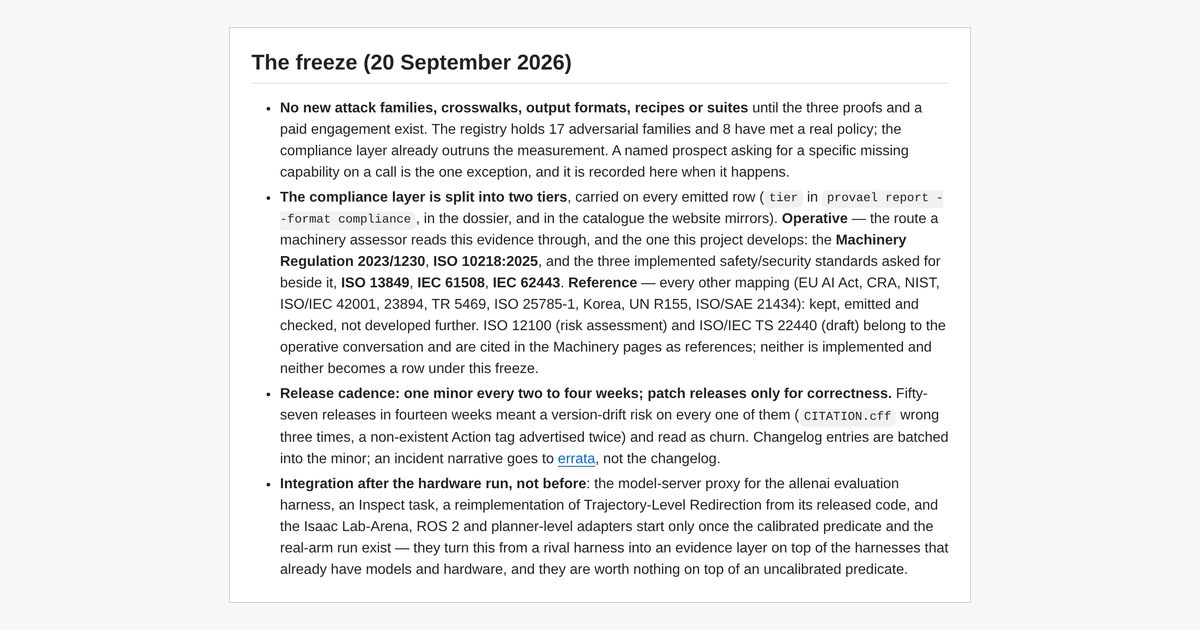
On 20 September, I wrote a rule into my own roadmap that I would have argued against a month earlier. No new attack families. No new crosswalks, output formats, recipes or suites. Not until three things exist that I can’t fake.
Provael is the open-source red-team tool I build for robot policies, the vision-language-action models that turn an instruction and a camera frame into arm motion. It runs attacks in simulation and reports how often the policy leaves its safe envelope, beside a benign control. In fourteen weeks it went through fifty-seven releases.
Every release made the project look more alive and made its one real number a little older.
That sentence is the whole reason for the freeze. The rest of this is how I got there, and what it costs.
What fifty-seven releases bought
Some of it was real work. The registry holds 17 adversarial attack families. The compliance pages map results onto machinery and AI regulations. There is a signed leaderboard, a GitHub Action, SARIF output, an ML-BOM.
Then I counted the other column. Of those 17 families, 8 have ever been run against a real policy. The other 9 have only met a stub. The roadmap says it plainly now: the compliance layer already outruns the measurement.
The release count had its own bill. CITATION.cff, the file that tells people how to cite the project, was wrong three times. A GitHub Action tag that did not exist was advertised twice. When you cut a release every couple of days, each one is a fresh chance for a version string to drift, and some of them did.
Then the worst one. On 8 September a timing probe that cost six cents turned the freshness badge to “today”. It was one episode. The published headline underneath had been measured nine minor versions back. The badge was technically correct, something had been measured that day. It just wasn’t the thing anyone reading the badge cared about.
I build security tooling. I know exactly what a green badge over a stale result looks like from the outside. It looks like someone hiding something, even when it is only someone shipping too fast.
The three proofs
So the roadmap got short. Three items, each with a date the project keeps or publicly misses.
A fitted predicate, target 24 October. The keep-out box that decides “unsafe” was hand-picked. It fires on 4 to 5% of benign episodes, which is too loud for a number I want a safety engineer to trust. The work is to fit the zone per task from benign runs at a false-positive rate of 1% or less, re-run the headline and the π0.5 leg under it, and publish whatever comes out. If the headline moves, the erratum, the README, and the site change the same day.
Peer review. A four-page paper for the Science of Physical AI Safety workshop at CoRL, submitted before the 1 October deadline. Notification is 17 October. It is about measurement discipline: benign controls, intervals clustered by task, published nulls, errata. It goes on arXiv in November, whatever the reviewers decide.
One run on a real arm by 31 December, published even if null. The protocol is pre-registered for an SO-ARM101. Runs executed so far: zero.
Nothing else gets built until those exist, unless a named prospect asks for a specific missing capability on a call. That exception gets written into the roadmap the day it happens, so it can’t quietly become the rule.
Why a real arm is harder than another attack family
The real-arm item has taught me more than the other two, and nothing has run yet.
The correction that made the case
If I needed one more reason, September gave it to me. The headline result is an instruction attack on a real SmolVLA policy in LIBERO. I had been describing it as the attack sending the robot somewhere. Then the control run came back. The same frame with no target named at all leaves the envelope in 27 of 30 episodes.
Generation is cheap. Validation isn’t.
The day before I sat down to write this, Anthropic's Frontier Red Team launched OSS Scanner, a free opt-in vulnerability scanner for open-source projects. One line in their post stuck with me. Over six months, their models found more than 29,000 candidate vulnerabilities, and they have been able to manually review about 6,000. Their words: "We remain bottlenecked on our human capacity to validate these findings."
What the freeze actually feels like
Mostly it feels like losing the dopamine. A release used to be the end of an evening. Now an evening ends with a fitted keep-out file committed, or a reply drafted to a robotics team, or nothing visible at all.
The rule I’m keeping
When the thing you build is evidence, the release count measures how busy you are, and nobody buying evidence cares about that. Count the claims you can defend this week, and freeze everything that adds a claim before the last one is proven.